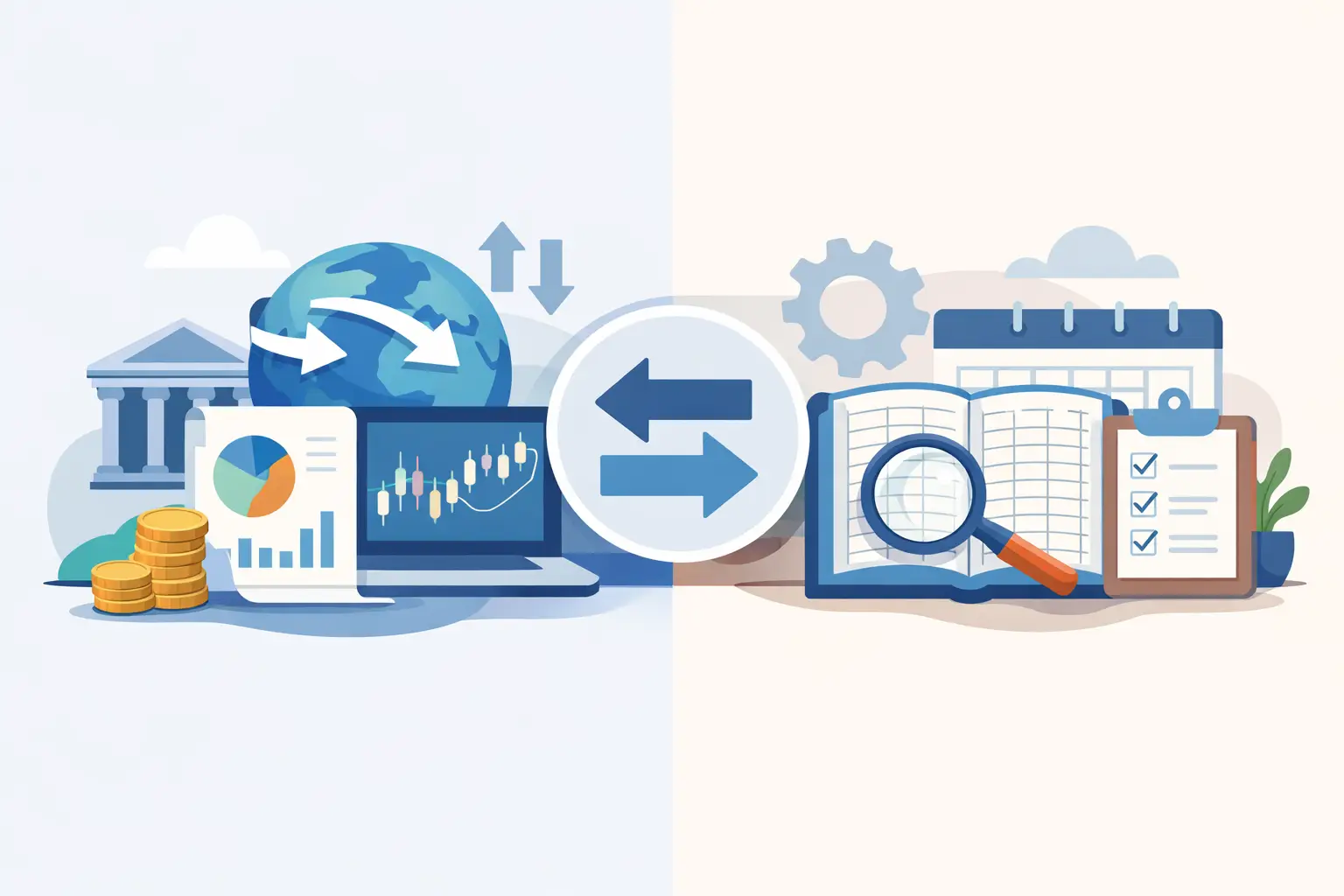
A spreadsheet can record a buy, a sell, and a balance. That does not mean it can run an exchange. The gap between exchange accounting vs bookkeeping becomes obvious the moment your operation handles multiple asset classes, branch activity, role-based approvals, and real-time profit visibility. For exchanges, bookkeeping is only one layer of the financial stack. Accounting is the control system.
Why exchange accounting vs bookkeeping matters
For a small business, bookkeeping often means recording transactions, reconciling accounts, and preparing reports for tax and management review. That model works when the business sells a limited number of products, receives standard payments, and closes its books on a predictable cycle.
An exchange operates under a different level of operational pressure. Transactions move continuously. Asset values shift during the day. Customer balances, treasury balances, branch cash positions, and trading spreads all affect financial truth in real time. If the finance function only records what happened after the fact, leadership is managing with a delay.
That is the core difference in exchange accounting vs bookkeeping. Bookkeeping captures entries. Exchange accounting governs the financial reality of a live, high-volume, multi-asset business.
What bookkeeping does well - and where it stops
Bookkeeping is still necessary. Every exchange needs clean records, consistent classifications, reconciled balances, and a dependable audit trail. Without that foundation, reporting quality drops fast.
At its best, bookkeeping handles the mechanics of financial recordkeeping. It logs deposits and withdrawals, records fees, tracks expenses, matches bank activity, and helps produce standard financial statements. If your operation is early stage, has low transaction volume, and supports a narrow set of assets, a bookkeeping-centered process may appear sufficient for a while.
The problem is scale and complexity. Generic bookkeeping tools are usually built for businesses with one base currency, simple user permissions, and month-end reporting habits. Exchanges rarely fit that profile. Once you add crypto, fiat, precious metals, or commodity-linked positions, the bookkeeping layer starts carrying responsibilities it was not designed to manage.
That is when teams compensate with spreadsheets, manual journals, side reconciliations, and disconnected reporting workflows. Accuracy becomes dependent on individual effort instead of system design.
What exchange accounting is actually responsible for
Exchange accounting goes beyond recording history. It manages financial control across operations, assets, users, and reporting periods.
In practice, that means the system must support automated dual-entry logic, real-time asset valuation context, branch-level oversight, treasury movement visibility, and controlled access across finance and operations teams. It also needs to reflect business-specific events correctly. A customer deposit is not just cash movement. A trade fee is not just revenue. An internal transfer is not just a balance shift. Each event affects multiple ledgers, control accounts, and reporting views.
This is why exchange accounting is infrastructure, not just admin. It gives finance leaders an operating position they can trust while the business is moving.
Exchange accounting vs bookkeeping in a multi-asset environment
The distinction becomes sharper when an exchange handles more than one asset type.
A bookkeeping workflow may record Bitcoin, USD, and gold transactions as separate lines with converted values attached. That can help with basic recordkeeping, but it does not automatically create operational clarity. The finance team still needs to know which balances are customer liabilities, which are house assets, which movements are internal, which exposures are unrealized, and how profitability shifts by asset, branch, or desk.
Exchange accounting is built to answer those questions without forcing teams into off-system analysis. It structures the books so that digital and traditional assets can coexist inside one controlled framework. That matters because valuation, reconciliation, and reporting behave differently across asset classes. Crypto settles differently than bank transfers. Commodity-linked operations create different oversight demands than pure fiat flows. A system that treats all activity as generic bookkeeping entries will eventually produce blind spots.
Real-time visibility changes the standard
Traditional bookkeeping is often retrospective. Exchange accounting cannot afford to be.
Owners and finance teams need to see margin performance, operational balances, fee income, and liquidity positions as activity unfolds. If profit and loss is only clear at the end of the month, pricing errors, reconciliation breaks, branch leakage, or treasury mismatches can stay hidden for too long.
This is one of the most practical reasons to evaluate exchange accounting vs bookkeeping seriously. The issue is not terminology. It is decision speed. An exchange makes daily decisions on spreads, risk, staffing, branch funding, and capital allocation. Those decisions require current numbers, not reconstructed numbers.
Real-time insight also improves control. When a variance appears immediately, teams can isolate the source while evidence is still fresh. When the same variance is discovered weeks later during a bookkeeping cleanup, the operational cost is much higher.
Control, permissions, and auditability
Bookkeeping software typically assumes a limited user environment. An exchange often has finance managers, branch operators, treasury staff, executives, and auditors interacting with the same financial system at different authority levels.
That is not just a convenience issue. It is a risk issue.
Exchange accounting must support role-based control so users can perform their function without exposing the full financial environment unnecessarily. Approval workflows, access restrictions, and action logs are part of accounting design in this setting. They help reduce internal risk, support compliance readiness, and preserve accountability across high-volume operations.
Bookkeeping records what was entered. Exchange accounting also governs who can enter it, who can approve it, and how that action becomes part of a defensible audit trail.
When bookkeeping is enough - and when it is not
There are cases where bookkeeping-first operations make sense. A newly launched exchange with low daily volume, limited assets, and centralized oversight may choose a lighter setup in the beginning. If transaction flow is manageable and the team can reconcile activity without operational strain, the simpler model may be cost-effective for a short period.
But the threshold arrives faster than many teams expect. More branches, more users, more asset classes, and more transaction volume expose the limits quickly. Once finance depends on exports, manual adjustments, or after-hours reconciliation to explain business performance, the operation is already paying the cost of underbuilt accounting infrastructure.
The question is not whether bookkeeping has value. It does. The question is whether bookkeeping alone can support the control model your exchange requires.
What to look for beyond bookkeeping
If your exchange is evaluating systems, focus less on generic accounting labels and more on operational fit.
A capable exchange accounting environment should automate double-entry treatment at transaction level, centralize asset and liability visibility, support multiple asset classes in one structure, and provide real-time profit and loss visibility without manual rework. It should also handle migration cleanly, because replacing fragmented tools often creates as much risk as keeping them.
The strongest platforms are designed around exchange behavior rather than adapted from general small-business accounting. That difference affects speed, accuracy, and executive confidence. Arzfy, for example, is built around exchange-specific accounting operations rather than generic bookkeeping workflows, which is exactly the distinction sophisticated operators need to evaluate.
The strategic cost of choosing the wrong layer
Treating an exchange like a standard bookkeeping case can create hidden drag across the business. Finance closes take longer. Reconciliations absorb senior time. Leadership waits for usable numbers. Audit prep becomes heavier. Internal control depends on process discipline rather than platform enforcement.
Those costs rarely appear as one dramatic failure. They show up as friction. A delayed report here, an unexplained variance there, an approval gap that forces manual review, a branch issue that takes days to isolate. Over time, that friction limits growth.
Exchange accounting reduces that drag by turning finance into a live operational function. That is especially important in businesses where customer trust, asset accuracy, and reporting discipline are not optional.
If you are comparing exchange accounting vs bookkeeping, the practical test is simple: do you need records, or do you need control? Most exchanges need both. The difference is that bookkeeping preserves the past, while exchange accounting helps run the business in the present. Choose the system that matches the pressure your operation is already under, not the one it outgrew six months ago.