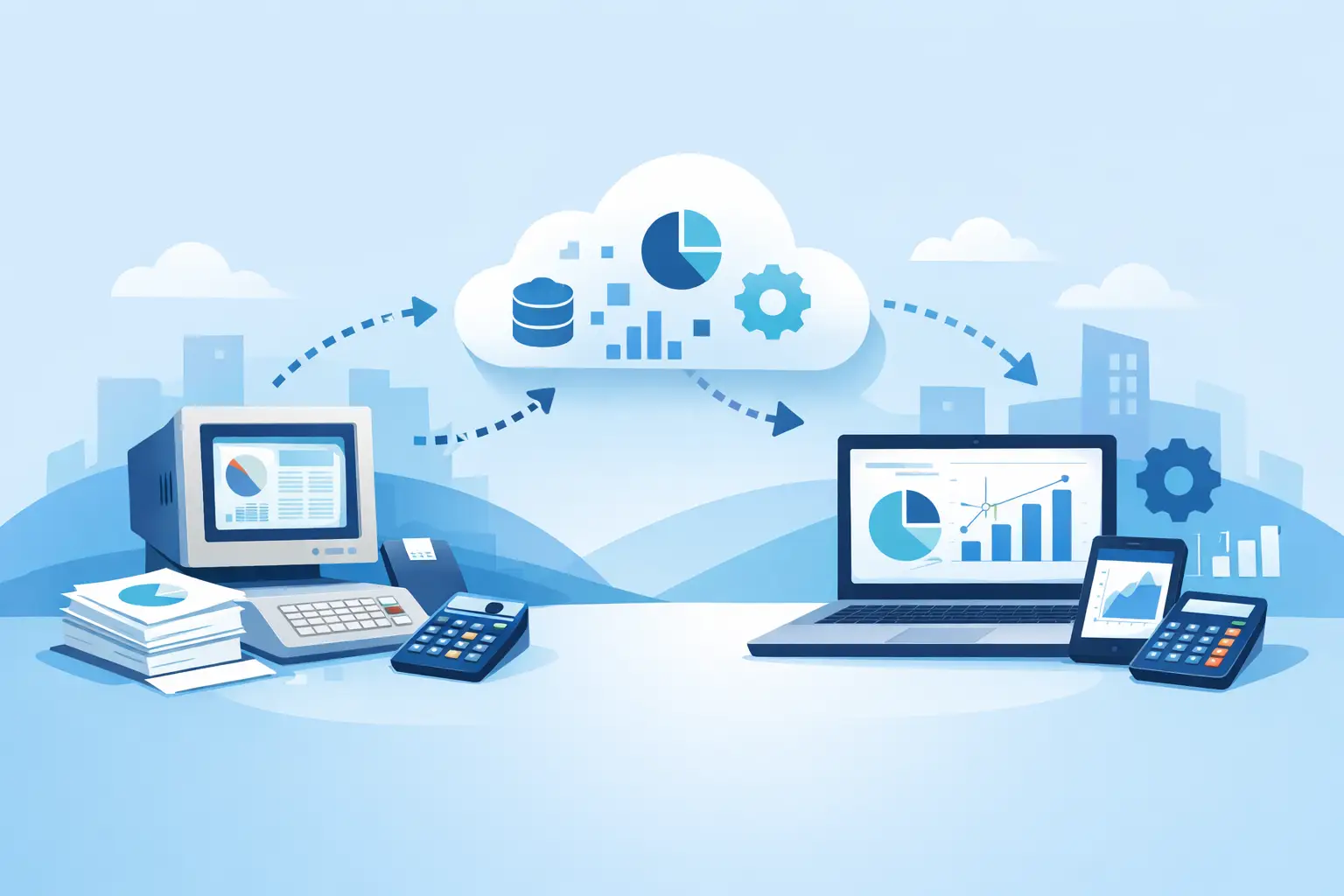
Most exchange finance teams do not decide to replace old systems because they want a new interface. They decide because the current setup is slowing down close cycles, hiding profitability by asset or branch, and forcing staff to patch serious accounting work with spreadsheets. That is when legacy accounting software migration stops being an IT project and becomes an operational control issue.
For exchanges handling crypto, fiat, and other asset classes, the cost of staying on outdated software is rarely limited to inefficiency. It shows up in delayed reporting, inconsistent balances, weak permission controls, and too many manual workarounds around journal entries, reconciliations, and branch-level oversight. Migration matters because finance cannot lead from a fragmented system.
Why legacy accounting software migration gets delayed
Most teams know their legacy stack is a problem long before they replace it. The delay usually comes from one concern: risk. If the accounting platform sits at the center of settlements, cash visibility, asset tracking, and executive reporting, changing it can feel more dangerous than keeping a flawed system in place.
That concern is valid. A rushed migration can create reporting gaps, duplicate records, broken mappings, and confusion over who owns the new controls. But delay has its own cost. Every month spent on disconnected tools increases reconciliation effort and makes audit trails harder to defend. In exchange environments, that cost compounds quickly because transaction volume and asset complexity do not stay flat.
The real question is not whether to migrate. It is whether the migration approach reflects the operational reality of the business.
What makes exchange accounting migrations different
A standard accounting migration plan often assumes one base currency, simple entity structures, and limited operational roles. That model breaks down fast in exchange businesses.
An exchange may need to track crypto and fiat side by side, isolate branch performance, control access by role, and report real-time profit and loss across multiple business lines. Some also manage exposure tied to commodities like gold or oil. Legacy tools were rarely built for that level of asset diversity and operational segmentation.
This is why software replacement alone is not enough. The destination platform has to support the actual accounting architecture of the business. If it cannot handle dual-entry accounting across asset classes, granular permissions, and real-time visibility, the team simply migrates old problems into a newer interface.
Start with process design, not data export
One of the most common mistakes in legacy accounting software migration is treating the project as a data transfer exercise. Export the old ledgers, import them into the new system, and assume the job is done. That approach ignores the reason the migration started.
A better starting point is process design. Before moving balances, define how the business should operate in the new environment. That means clarifying chart of accounts structure, entity and branch logic, user roles, approval flows, reporting requirements, and reconciliation responsibilities.
If the old system allowed inconsistent naming, duplicate account usage, or unclear ownership between finance and operations, those issues need to be corrected before migration. Clean process design reduces implementation friction and gives leadership a system they can actually govern.
Data quality decides the outcome
No migration framework can compensate for bad source data. If customer balances, asset mappings, branch allocations, or historical journals are inconsistent, the new platform will expose those issues immediately.
This is where disciplined review matters. Teams should identify which historical data must move for compliance, audit, and operational continuity, and which data can be archived outside the live environment. Not every record belongs in day-one production. Trying to migrate every legacy exception often delays go-live and increases risk without improving financial control.
The smarter approach is selective completeness. Migrate what the business needs to operate, report, and defend. Archive what must be retained but does not need to sit inside daily workflows.
A practical framework for legacy accounting software migration
The strongest migrations usually follow a controlled sequence rather than a single cutover event. First, define the operating model. Second, validate the data. Third, configure the new system around real processes instead of generic templates. Fourth, test reporting, balances, and permissions in parallel before full adoption.
Parallel testing is especially important for exchange finance teams. If the new platform produces different branch P&L, asset balances, or reconciliation outcomes than the old stack, that variance needs investigation before production reliance increases. Sometimes the old system was wrong. Sometimes the mapping is wrong. Either way, the team needs a controlled method for resolving differences.
Training also deserves more attention than it gets. Executives need dashboard-level visibility. Finance needs confidence in journals, close processes, and reporting outputs. Operations teams need clarity on permissions and handoffs. Migration succeeds when each role knows what changed and why.
The trade-offs leadership should expect
There is no perfect migration path. A fast cutover reduces the time spent operating two systems, but it raises pressure on testing and training. A phased rollout lowers immediate disruption, but it can extend complexity if the old and new environments must coexist for too long.
The right choice depends on transaction volume, asset complexity, internal readiness, and regulatory pressure. A smaller exchange with a contained process footprint may benefit from a rapid deployment. A multi-branch operation with diverse assets and layered approvals may need a more structured transition.
Leaders should also expect some short-term friction. Standardization often feels restrictive to teams that are used to spreadsheet flexibility. But that restriction is usually a sign of stronger control. The goal is not to preserve every local workaround. The goal is to build a finance operation that is faster, more accurate, and easier to audit.
What to look for in the target platform
The destination system should do more than accept imported balances. It should improve how accounting works every day.
For exchange businesses, that means real-time financial visibility, support for multiple asset classes, strong role-based access control, and an architecture that can handle operational scale without depending on external spreadsheets. Security and uptime are not secondary concerns. If finance relies on the platform for live oversight, outages and weak controls become business risks, not technical inconveniences.
It is also worth examining how quickly the system can be configured for your actual workflows. Long implementation cycles are not always a sign of depth. Sometimes they signal poor fit. Platforms built for generic bookkeeping often need heavy adaptation in exchange environments. Systems designed for exchange operations reduce that gap because the core logic already reflects how the business runs.
This is where a specialized accounting OS can materially change the migration equation. Arzfy, for example, is built for exchanges managing digital and traditional assets in one environment, with centralized oversight, role-based control, and real-time reporting designed for operational finance teams.
Signs your migration plan is on the right track
The best early indicator is clarity. Teams know what data is moving, what is being archived, who owns validation, and what success looks like at go-live. There is a documented mapping between old and new structures. Reconciliations are tested. Access permissions are assigned deliberately, not copied blindly from old habits.
Another good sign is that reporting improves before the project is even finished. As data is cleaned and processes are standardized, leadership begins to see where profitability, operational leakage, and manual effort were previously hidden. Migration is not just a replacement event. Done properly, it sharpens financial management.
A final sign is confidence at close. When the finance team can produce timely statements, explain balances clearly, and trace operational activity without spreadsheet firefighting, the migration has moved beyond implementation and into control.
Why waiting usually costs more than moving
Legacy systems rarely fail all at once. They fail by degrees. First, reporting slows down. Then exceptions increase. Then finance starts carrying knowledge in people instead of systems. Eventually, decision-making depends on manual reconciliation and institutional memory.
That is a fragile model for any financial business, and it is especially risky for exchanges with high transaction volume, multiple assets, and distributed teams. The longer the business grows on top of an outdated accounting foundation, the more expensive the eventual correction becomes.
A well-run migration does require planning, discipline, and executive attention. But it also creates something legacy software cannot provide: current-state control. That matters when finance needs to move from record keeping to real operational leadership.
If your team is still compensating for system limits with spreadsheets, workarounds, and delayed visibility, the issue is no longer software age. It is whether your accounting infrastructure still matches the business you are actually running.