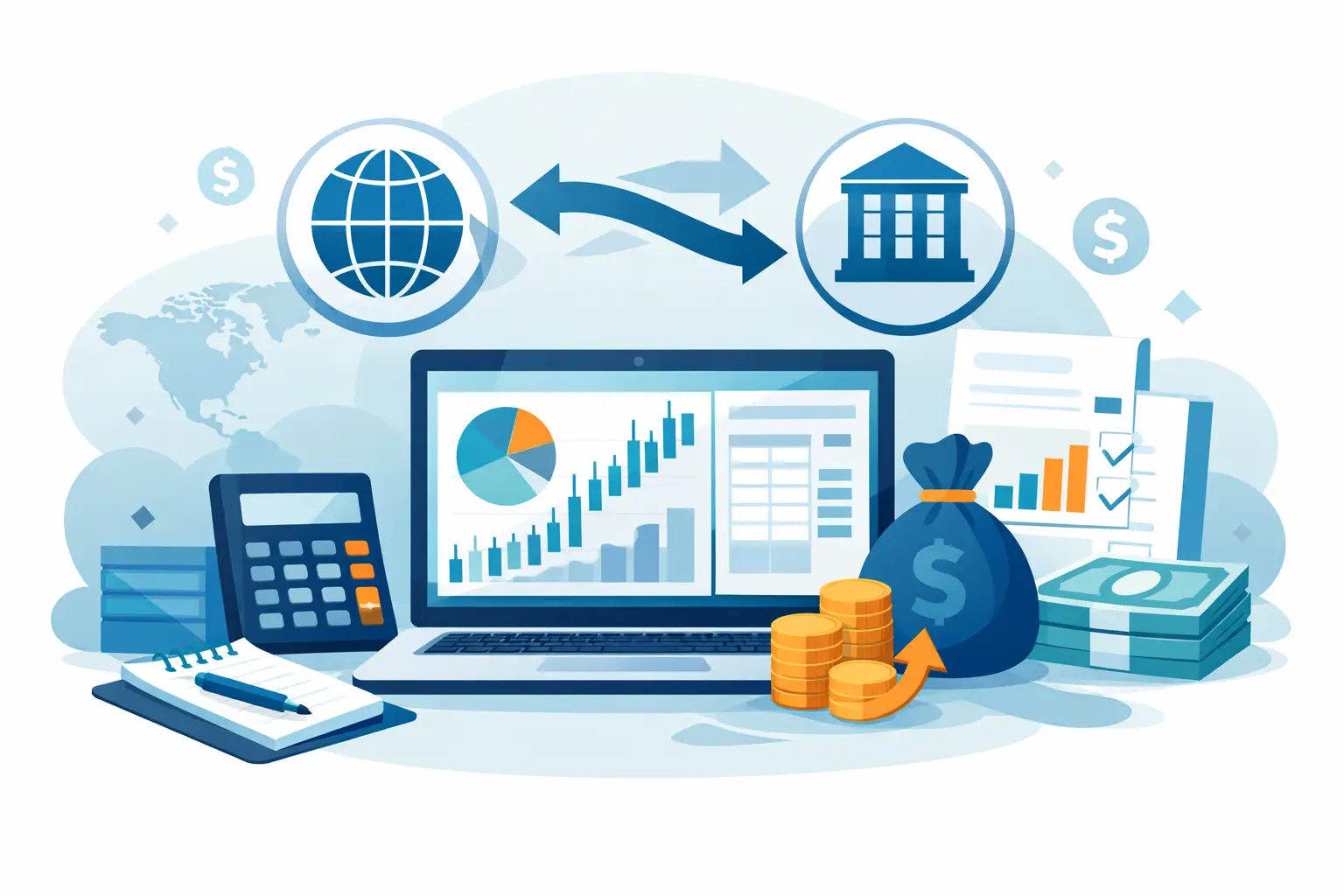
If your finance team is still closing books across spreadsheets, wallet exports, bank statements, and branch reports, the real issue is not speed. It is control. That is exactly where the question what is exchange accounting software becomes practical, not theoretical.
Exchange accounting software is a purpose-built financial operating system for businesses that buy, sell, convert, hold, and reconcile multiple asset types at high transaction volume. Unlike generic accounting tools, it is designed for exchange workflows from the start. That includes crypto and fiat movement, branch activity, treasury balances, customer trades, spread revenue, fees, internal transfers, and real-time profit and loss visibility across the business.
For an exchange, accounting is not just about recording debits and credits after the fact. It is part of daily operations. The software has to keep up with moving balances, asset conversions, role-based approvals, and reporting requirements without creating delays or manual cleanup.
What is exchange accounting software built to handle?
A standard bookkeeping platform usually assumes a simpler environment: one base currency, predictable ledger structures, and a limited number of transaction types. Exchanges do not operate in that environment.
An exchange may be managing USD, USDT, BTC, gold, and oil positions in the same business. It may also be running multiple branches, multiple cash points, and multiple user roles with different permissions. Every transaction changes more than one thing at once - balances, valuation, exposure, fees, and realized income. Exchange accounting software is built to capture that complexity without forcing finance teams to patch the gaps manually.
At its core, the system centralizes accounting, asset tracking, reconciliation, and reporting in one environment. It records transactions using exchange-specific logic, maintains dual-entry integrity, and gives finance and operations teams a live view of what the business actually owns, owes, earns, and risks.
That matters because delayed visibility is expensive. If profitability is only clear at month-end, leadership is managing with old information. If balances need manual verification, operations slow down. If branch activity cannot be monitored centrally, control weakens exactly where errors tend to grow.
How exchange accounting software differs from general accounting tools
The difference is not branding. It is architecture.
General accounting software is built for broad business categories such as retail, services, or standard corporate finance. It can often be adapted for an exchange, but adaptation creates friction. Teams end up relying on spreadsheets, custom journals, manual imports, and side systems just to produce a complete financial picture.
Exchange accounting software starts with the assumption that the business is transaction-heavy, asset-diverse, and operationally sensitive. It expects movement between wallets, vaults, bank accounts, branches, and trading desks. It expects revenue to come from spreads, commissions, service charges, or asset revaluation. It expects internal transfers and customer-facing transactions to affect reporting in real time.
That changes the day-to-day experience. Instead of entering data in one system and correcting it in three others, finance teams work from a unified ledger environment. Instead of waiting for exports to reconcile crypto and fiat positions, they monitor balances and performance inside the same operational layer.
The core functions that matter most
The best way to understand what exchange accounting software does is to look at the problems it removes.
First, it automates dual-entry accounting at scale. Every asset movement, fee, and conversion should generate the correct accounting treatment automatically. That reduces manual posting and cuts the risk of silent errors that only appear during reconciliation or audit.
Second, it supports multi-asset accounting. Exchanges rarely work with one asset class. They may handle digital assets alongside fiat, commodities, or internally defined instruments. The software must track those assets separately while still giving leadership a unified financial view.
Third, it provides real-time profit and loss reporting. This is one of the biggest operational advantages. Finance and executive teams can see how branches, desks, currencies, or asset lines are performing without waiting for a close cycle. In a volatile market, delayed P&L is not a reporting inconvenience. It is a decision-making handicap.
Fourth, it strengthens control through permissions and approval structure. Exchanges often need role-based access for tellers, accountants, branch managers, finance leads, and executives. A purpose-built platform lets each role operate within clear boundaries while preserving oversight and audit trails.
Fifth, it simplifies reporting and reconciliation. When records are centralized, the process of matching wallets, bank accounts, internal books, and operational activity becomes faster and more reliable. That has a direct effect on close speed, audit readiness, and management confidence.
Why exchanges outgrow spreadsheets and generic tools
Most exchanges do not start with perfect infrastructure. Early-stage teams often run operations through a combination of accounting software, manual trackers, and custom exports. That can work for a period, especially when transaction volume is low and the business model is still evolving.
The problem starts when growth arrives. More branches create more cash movement. More assets create more valuation complexity. More staff create more access risk. More volume creates more reconciliation pressure. At that stage, spreadsheets stop being flexible and start becoming a source of delay, inconsistency, and exposure.
This is usually when leadership notices that accounting is too dependent on individual employees. If one person controls the logic behind daily reports or reconciliation files, the business does not have a stable operating system. It has institutional memory sitting in a spreadsheet.
Exchange accounting software replaces that fragility with process discipline. It standardizes transaction handling, reporting logic, and controls so the business can scale without multiplying financial risk.
Who needs exchange accounting software?
The short answer is any exchange business that needs accurate books and operational visibility across multiple assets or locations.
That includes crypto exchanges, OTC desks, remittance-led exchange businesses, and multi-asset firms handling fiat with commodities such as gold or oil. It is also relevant for businesses preparing to scale, not just those already at enterprise volume. Implementing specialized infrastructure early can prevent painful migrations later, although the timing depends on complexity, team size, and transaction growth.
A very small operation with narrow asset coverage may be able to survive on basic tools for a while. But once the business needs real-time oversight, branch-level accountability, or stronger internal controls, generic accounting software usually becomes the bottleneck.
What to look for in exchange accounting software
Not every platform marketed to financial businesses is actually built for exchange operations. Buyers should assess the fit based on operating demands, not feature counts alone.
The first question is whether the system supports the asset classes the business actually trades and holds. Multi-asset support sounds impressive, but the details matter. It should handle accounting logic, reporting, and reconciliation for each asset type without forcing workarounds.
The second is whether reporting is truly real time. Some systems claim visibility but still depend on delayed syncs or batch imports. For an exchange, real-time means finance and operations can rely on the numbers during the day, not only after a nightly process.
The third is migration practicality. If moving from legacy tools takes months of manual setup, the cost of switching rises fast. A platform built for exchanges should reduce migration friction, not create another project for the finance team to manage.
The fourth is security and access control. Bank-grade infrastructure, role-based permissions, and clean audit trails are not extras in this category. They are baseline requirements.
This is why specialized platforms such as Arzfy are gaining traction. They are not trying to be accounting software for everyone. They are built as accounting operating systems for exchanges that need speed, accuracy, uptime, and control in one place.
The business case is bigger than accounting
When people ask what is exchange accounting software, they often expect a narrow answer focused on bookkeeping. That misses the point.
For an exchange, accounting software affects operations, leadership visibility, compliance readiness, and customer-facing reliability. If balances are wrong, confidence falls. If reports are delayed, decisions slow down. If controls are weak, growth adds risk instead of value.
The right system turns accounting into infrastructure. It gives teams a reliable source of truth across assets, branches, and roles. It shortens close cycles, reduces manual errors, and makes profitability visible while there is still time to act on it.
That is the real shift. Exchange accounting software is not just a better ledger. It is the control layer that helps an exchange run with precision when transaction volume, asset diversity, and operational complexity start to rise.
If your business is still stitching that control together across disconnected tools, the better question is not what exchange accounting software is. It is how long your current setup can keep pace with the exchange you are building.